+ View Older Messages
| "Foxtrot Smooth which is 120 to 136 beats per minute recomended. Lets tranfer that to what the rest of the world uderstands which is 30BPM to 34BPM.. I think today you would have to hunt around to find a dance recording played at 34BPM."
Only because the dominant European labels are recording for the slower tempos preferred by international style, not the faster ones traditionally used for American style.
"The speed could be tampered with which can cause distortion as it also can also if the tempo is slowed down."
Commonly done regardless.
"Just for those interested from the rules of Dancesport. A Waltz is 30 BPM. Foxtrot 30 BPM."
Wrong wrong wrong. Those numbers are included in the allowed range, but it is
a range, not a single number. A foxtrot at 28 is perfectly legal, and probably preferred by most international style dancers.
Besides, who writes the rules for "Dancesport"? Multiple organizations, and they don't 100% agree with each other.
And those are the rules for international style. American style has different rules, made by the organizations that supervise its competitions.
"Would you believe like there they have this ridicules between 52 BPM to 56 BPM recomended for the same dance. This means you could dance one heat at 52 and the next at 56. Why on earth should that be."
Try working more on your dancing and less on your complaining. This is hardly any greater percentage change then the allowed tempo for international foxtrot, of 28-30 mpm (and you will in fact find foxtrots spanning that range on the same disk from leading labels)
|
| "I copied those tempos straight from a rules of Dancesport Book."
Not from any rulebook used by leading ballroom competitions you didn't.
"So are you happy to practice in your studio a Foxtrot at 28 BPM and find out when you reach the floor the music being played is 32."
Under which rules is such a range legal?
For my competitions, the legal range is 28-30.
I prefer the 28's, but find the 30's acceptable. If I were dancing a rhythmic foxtrot instead of a flighted one, then I'd probably be in a division with rules setting a slightly faster range of tempos. In that case, I might be used to 30-32's but not used to 28's or 29's.
"You wrote Wrong Wrong the numbers are included in the allowed range. Why would there be an allowed range on the competition floor."
(actually that's not what I wrote, you really should you copy and paste when quoting to avoid changing the meaning)
Try looking in the actual rules (online only, no more books in this day and age) of a real dance organization such as WDDSC or IDSF. I bet you'll find they match what is posted under learn the dances on this website: 28-30 mpm for international, and something like 30-34 for american. Maybe they allow the small resonable range that they do so that speed shifting (which you dislike) won't have to be used.
"I will pick you upon another point here. Go to Shopping. Then to Ultimate Ballroom Album 9. Cast your eyes to your right and you will see the Tempo for ten Foxtrots. What do you know ,they are all played at 116 beat per minute which is 29BPM."
Look around a bit more, you will find the range in leading European ballroom albums for foxtrots matches the rules of leading ballroom competitions - 28 to 30 mpm. Yes, the 28's are more popular and the 30's least, but they are all legal and they all do turn up on disks from leading publishers. If they put on a 27, they usually tag it as a show number.
"Are you happy to take to the floor not knowing if there is going to be a varience of some four bars per minute in the tempo played."
For foxtrot, interntional style, the range is only 2 mpm, not 4.
"If so please explain how this can be of an advantage to a dancer."
It gives you a chance to show that you aren't stuck in a rut like the other guy. That you are dancing, not merely performing a set piece in willfull ignorace of the situation where you find yourself.
"That is if in the studio, who will be in charge of the music train at the lowest tempo. Visitors suddenly find themselves dancing to a speed they are not trained for. That door should be completely slammed shut."
Then you had better either train at the range of tempos the APPLICABLE rulebook says you can encounter, or else take your ball and go home to your own room.
|
| "In my book of Dancesport Rules is says Foxtrot 30 BPM. Not between this and that."
The official rules of some of the leading competitions disagree with your mysterious, unnamed book. Go to the IDSF website and you will see an allowed range for the foxtrot of 28-30 mpm. WDDSC does say 30, but many of their national member organizations say 28-30.
"And again I would ask in American Smooth why is it between 30BPM. and 34BPM..What possible reason for having such a hugh gap between the two numbers can there be."
First, it's faster than international style as the dancing tends to be more rhythmic and less floating. The wider range could have several causes - Wider range of music that can be used without speed changing it. Wider range of opportunities for the dancers to adapt to. Because its not that big a deal actually. You sure complain a lot about a division you have never and probably will never dance in!
"If there are several heats of Foxtrot in a competition are you in favour of each heat being danced to a different Tempo."
Quite unlikley to happen. Each round my be a slightly different tempo, but usually each heat in the round will be the same song. You could argue this gives the advantage of a preview to the later heats, but it's just what usually happens, except maybe in the early rounds of a comp so huge that playing the same track that many times would drive everyone crazy. But early rounds are about seperating those who can from those who can't, the time to make fine artistic divisions amongst the srongest comes later.
"Surely it would be more professional to have one set Tempo for the, in this case, Foxtrot."
The actual professionals don't seem to have a problem with a REASONABLE range of tempos. If they did, the rules would probably change.
|
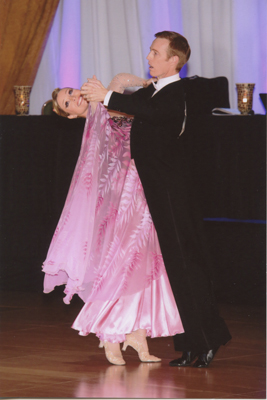
| I'loved the dancing but that music for both the Waltz and the Foxtrot was lousy in my opinion. |
| Wow! So much to love about those performances!
Besides the quality of the dancing, what makes her special is her expressiveness--it's really individual and so well integrated into her whole movement. Really impressive!
Plus, it's fabulous to know that you can win even if you aren't stick thin and you are wearing a black dress! I hope Lorena would take that as a compliment! I certainly mean it that way--as someone who isn't stick thin and who competes in a black dress ;>) |
| Thanks! I will take it as a compliment. Actually, thanks to everyone for your generous compliments. This has been an amazing experience for me and it's really great to hear that there are people that liked that performance, especially since I was sooo nervous at the time! As far as the music choices are concerned, I wasn't crazy about them, except for the foxtrot which I REALLY liked (it sounded much better in the ballroom than on the tape), but I didn't hate them either. While I'm sure that we could probably come up with some more or less objective set of criteria for what makes good music, as far as dancing is concerned, I feel that it ultimately comes down to personal taste. I happen to like very rhythmical foxtrots, but that's partly due to the fact that our choreography was created to that kind of music. I also realize that there are many people who hate that the music speed can vary as much as it does. I find this rather frustrated myself sometimes, especially when I'm not entirely familiar with a routine. However, once I'm comfortable with it, I rather like the challenge of having to interpret the same actions to fit with different types of music. Not to say that I'm always so successful with this, but it's a fun idea to play with.  Anyway, that's my two cents, for what it's worth. Again, thank you all for your kind comments. I really appreciate them; probably more than you might imagine.  |
| Loren. I have one question. Do you in the Smooth Style know what music is going to be played for your competition and therefore are able to train to that particular piece of music. Or is the first time you hear it is when you take to the floor. I only know the Inernational style and in a competition here in either Latin or Modern we have no idea what is going to be played untill it is played.
That is why I believe the correct tempo must be adhered to. And if the music has a vocalist care should be taken in the selection. I was told by a person who was actually in the Professional final of a Rumba in Europe that the whole field stopped dancing and everything came to a halt.The music became impossible to dance to.
By the way you didn't look nervous at all. On the contrary you appeared to ooze with confidence. Again well done. |
| Procedures are the same as for international style competition, only the table of tempos and rules concering hold are different. |
| Just cant get used to no tails--kinda takes away from the elegance of the performance . |
| Sorry Folks to be the odd one out but as an international competitor I Hated it. Although the Lady's looked lovely with nice poise,lines and flow,the men looked pompous constantly outdoing the Lady's with their lines and hand movements,not one man seemed to be showing off his partner or giving her the center of attention,at times the couples were so far apart that it looked like the men were dancing together. |
+ View More Messages
|